
Boeing AH-64 Apache
The US Army's primary attack helicopter — the definitive anti-armour rotorcraft.
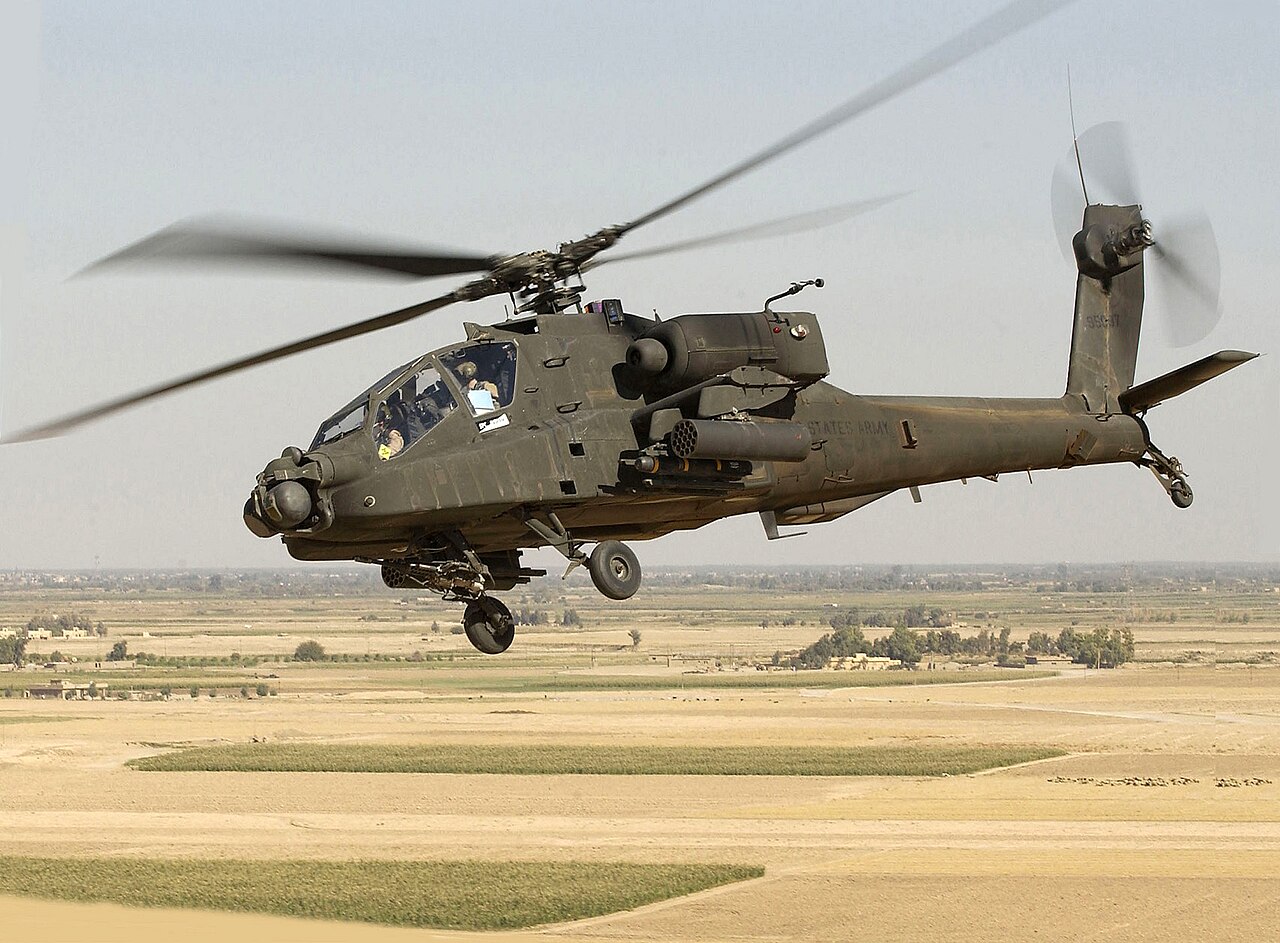
History & background.
The Boeing (formerly Hughes, then McDonnell Douglas) AH-64 Apache entered US Army service in 1986 as the most capable dedicated attack helicopter ever built. Developed following the cancellation of the AH-56 Cheyenne, the Apache was designed around a specific threat: massed Soviet armour advancing through the Fulda Gap into West Germany. The aircraft was optimised to survive in that environment — armed with Hellfire anti-tank missiles, protected against 23mm cannon fire, and capable of night operations through the PNVS and TADS sensor systems mounted on the nose.
The Apache’s 30mm M230 chain gun, mounted on an articulated chin turret, fires 625 rounds per minute. In the primary anti-armour role the aircraft carries up to 16 AGM-114 Hellfire missiles — enough to destroy an entire company of tanks in a single pass. The Longbow version of the Hellfire uses millimetre-wave radar guidance for fire-and-forget engagement in degraded visibility.
AH-64 Variants: A, D Longbow, and E Guardian
AH-64A — The original production variant introduced in 1986, equipped with the AN/ASQ-170 Target Acquisition and Designation Sight (TADS) and AN/AAQ-11 Pilot Night Vision Sensor (PNVS). Maximum speed 293 km/h, range 476 km.
AH-64D Longbow — The most significant upgrade, adding the AN/APG-78 Longbow millimetre-wave fire control radar mounted above the rotor hub. The radar enables simultaneous detection of up to 256 targets and fire-and-forget Hellfire engagement without line-of-sight. The AH-64D entered service in 1997 and was the primary US Army variant through the 2000s and 2010s.
AH-64E Guardian — The current production standard, featuring uprated General Electric T700-GE-701D engines (1,265 kW each), a full digital architecture, improved composite rotor blades, and the ability to control unmanned aerial vehicles (UAVs) directly from the cockpit. The AH-64E has a cruise speed of 279 km/h and is the variant operated by most recent export customers including India and Saudi Arabia.
The AH-64 has seen combat in every major US military operation since 1991. Apache crews flew the opening strikes of Operation Desert Storm, destroying Iraqi air-defence radar sites with Hellfires to clear a corridor for the coalition air campaign. Operations in Kosovo, Afghanistan, Iraq, and Syria confirmed the Apache’s ability to provide close air support in complex urban environments — a role the original design did not prioritise but which all variants have proven well-suited for.
Specifications & performance.
| cruise speed | 279 km/h (AH-64E) |
| engine | 2× GE T700-GE-701D (1,265 kW each) |
| first flight | September 30, 1975 |
| length | 17.73 m (fuselage) |
| max speed | 293 km/h (VNE 365 km/h) |
| mtow | 10,433 kg |
| primary weapons | M230 30mm chain gun, AGM-114 Hellfire, 70mm HYDRA rockets |
| range | 476 km (standard) |
| rotor diameter | 14.63 m |
| service ceiling | 6,096 m (20,000 ft) |
| status | In service (1986–present) |