
Bell X-1
The aircraft that broke the sound barrier — Chuck Yeager's Glamorous Glennis.
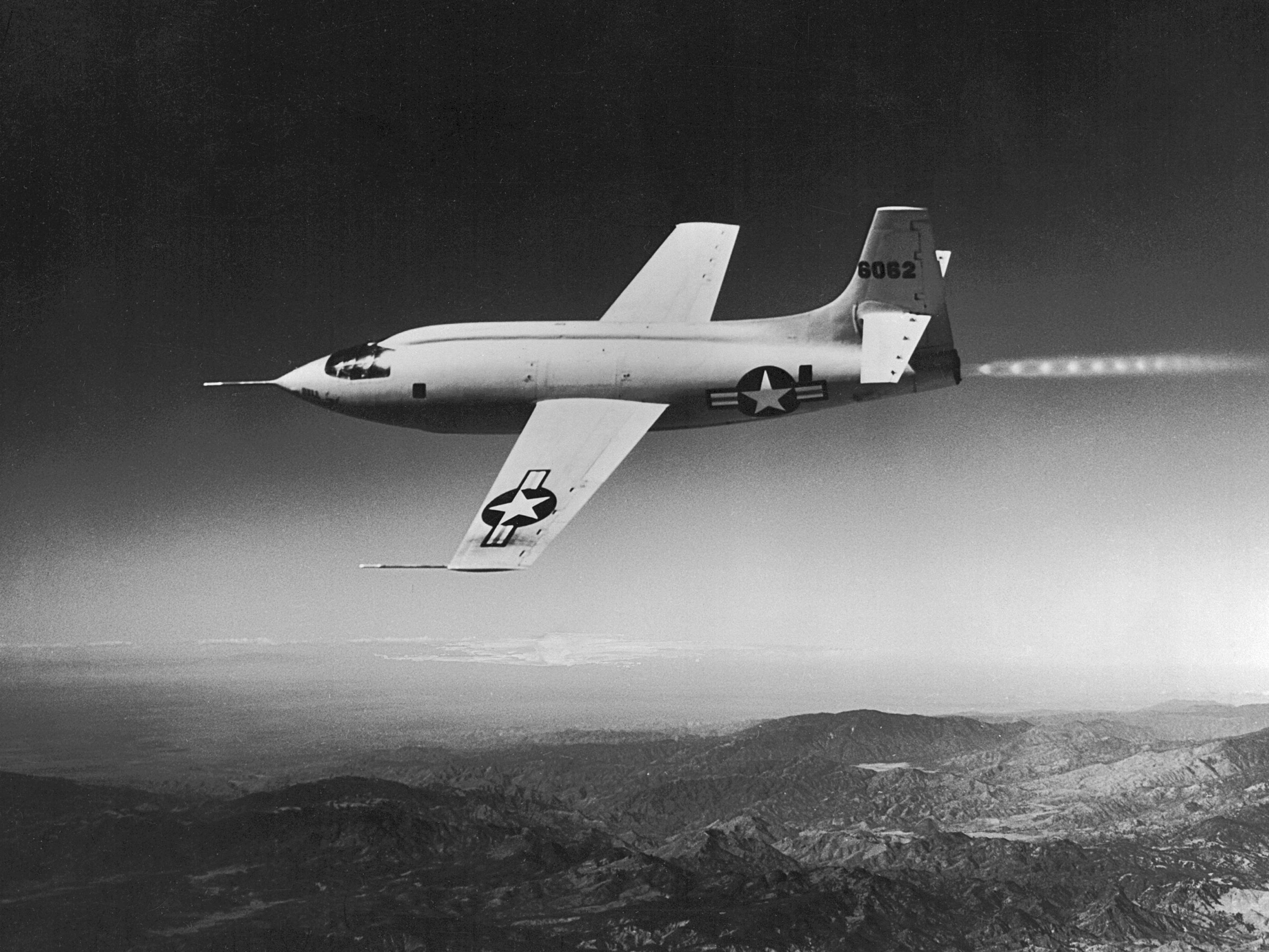
History & background.
On October 14, 1947, Captain Charles ‘Chuck’ Yeager climbed into the cockpit of the Bell X-1 — which he had named Glamorous Glennis after his wife — at an altitude of 7,620 metres below the wing of a Boeing B-29 Superfortress. He had two broken ribs from a horse-riding accident two days earlier, which he had not disclosed to his superiors for fear of being grounded. When the X-1 was released and Yeager ignited its four-chamber XLR11 rocket engine, he became the first human being to sustain controlled level flight faster than the speed of sound — Mach 1.06.
The sound barrier had represented a genuine engineering mystery in the 1940s. Wind tunnel data was unreliable near Mach 1 due to shockwaves forming in the tunnel itself, and several high-speed dive tests in conventional aircraft had ended in structural failures and deaths. Many engineers and pilots believed that shock wave formation at transonic speeds represented an insurmountable physical barrier. The X-1’s bullet-shaped fuselage, modelled on a .50-calibre machine gun round known to be stable at supersonic speeds, and its razor-thin wings without the symmetrical profile used on conventional aircraft, were the key design insights.
The Bell X-1 programme continued after Yeager’s historic flight, progressively pushing the speed record higher. The X-1A variant reached Mach 2.44 in 1953, also piloted by Yeager. The original X-1 in which the sound barrier was broken is preserved at the Smithsonian National Air and Space Museum in Washington D.C., where it hangs alongside the Wright Flyer and Charles Lindbergh’s Spirit of St Louis — the three most historically significant aircraft in American aviation.
Specifications & performance.
| engine | 1× Reaction Motors XLR11 (26.7 kN, 4-chamber) |
| first flight | January 25, 1946 (glide); December 9, 1946 (powered) |
| flights | 78 (X-1 Glamorous Glennis) |
| fuel | Ethyl alcohol + liquid oxygen |
| length | 9.4 m |
| max altitude | 21,900 m (71,900 ft) |
| max speed achieved | Mach 2.44 (X-1A variant, 1953) |
| mtow | 6,078 kg (fuelled) |
| sonic barrier flight | Mach 1.06 (October 14, 1947) |
| status | Retired (1958); on display at NASM, Washington D.C. |
| wingspan | 8.53 m |