
Concorde
The supersonic airliner that crossed the Atlantic in 3.5 hours — and retired to silence.
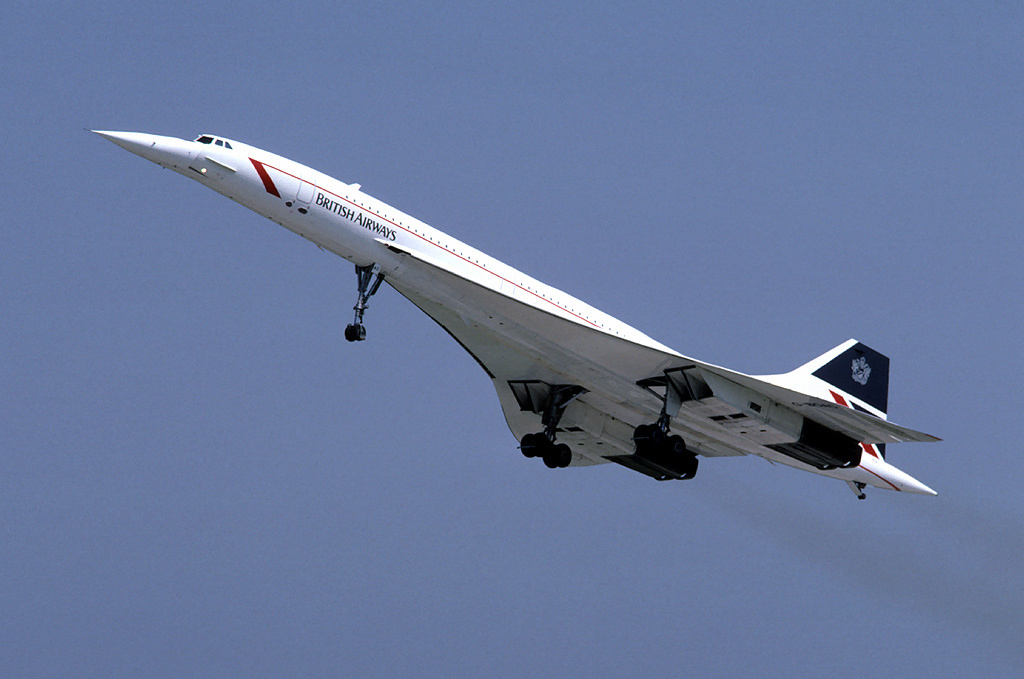
History & background.
Concorde was the only supersonic commercial airliner to enter regular passenger service and sustain it for decades. Jointly developed by British Aerospace and Aérospatiale, it flew its first commercial flights simultaneously from London and Paris on January 21, 1976, and operated without interruption for 27 years. In its prime, Concorde crossed the North Atlantic in under 3.5 hours — a journey that took subsonic jets nearly twice as long.
At its official cruise speed of Mach 2.04 (2,179 km/h) and cruising altitude of 18,000 metres (59,000 feet), Concorde flew in the stratosphere where the thin atmosphere reduced drag sufficiently to sustain supersonic flight on its four Rolls-Royce/SNECMA Olympus 593 afterburning turbojets. Aerodynamic friction heated the nose to +127°C, expanding the aluminium airframe by approximately 30 cm in flight. The iconic drooped nose — which lowered 12.5° for takeoff and landing to give the pilots a forward view over the long ogival delta wing — became the aircraft’s defining visual feature.
Concorde Variants and Production
Twenty Concorde airframes were built in total. Two prototype aircraft (001 and 002), two pre-production airframes (01 and 02), and sixteen production aircraft were constructed between 1965 and 1979. Of the production aircraft, fourteen entered passenger service: seven with British Airways (Series 100, designated 102) and seven with Air France (Series 100, designated 101). All service aircraft shared an identical performance specification: Mach 2.04 cruise, 18,300 m service ceiling, 7,250 km range, and seating for exactly 100 passengers in a single business class. The two unsold production aircraft were ultimately donated to museums.
The Crash and Retirement
On July 25, 2000, Air France Flight 4590 crashed on takeoff from Paris Charles de Gaulle, killing all 109 people on board and 4 on the ground. The cause was a titanium strip on the runway that punctured a tyre, sending debris into a fuel tank and igniting a catastrophic fire. The Concorde fleet was grounded, returned to service in November 2001 with enhanced tyre and fuel tank protection, but the combined effect of reduced post-9/11 business travel and Airbus withdrawing technical support made continued operation uneconomical. Both British Airways and Air France retired their fleets simultaneously in October 2003.
Concorde’s cultural legacy far exceeded its commercial footprint. For a generation it represented the pinnacle of technological ambition in civil aviation. No supersonic passenger aircraft entered scheduled service in the two decades that followed its retirement.
Specifications & performance.
| cruise speed | Mach 2.04 (2,179 km/h) at altitude |
| engine | 4× Rolls-Royce/SNECMA Olympus 593 (169.3 kN each with reheat) |
| first flight | March 2, 1969 |
| length | 61.66 m (expands 30 cm in flight) |
| max speed | Mach 2.23 (never-exceed) |
| mtow | 187,700 kg |
| range | 7,250 km (transatlantic) |
| seating | 100 passengers (standard) |
| service ceiling | 18,300 m (60,040 ft) |
| status | Retired (2003); 20 airframes preserved worldwide |
| wingspan | 25.61 m (ogival delta) |