
Sikorsky UH-60 Black Hawk
America's iconic utility helicopter — the backbone of US Army air mobility since 1979.
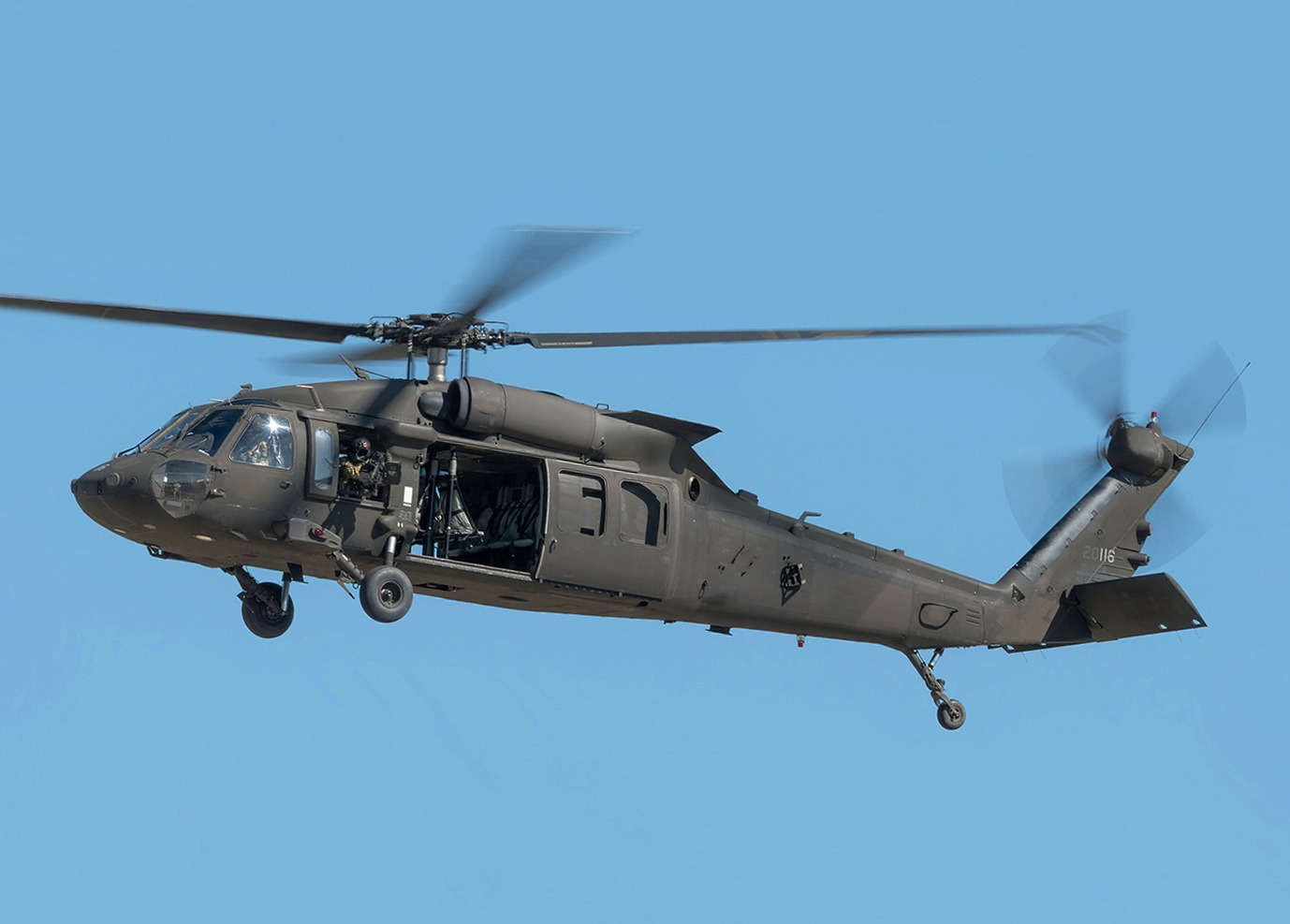
History & background.
The Sikorsky UH-60 Black Hawk has been the primary utility helicopter of the United States Army since replacing the Bell UH-1 Iroquois in 1979. Named after the Sauk war leader Black Hawk, the aircraft was designed to transport an 11-man infantry squad with full combat equipment in conditions that degraded or defeated the Huey — primarily at high altitude in the mountains of Central Europe, where a potential Warsaw Pact conflict was expected to occur.
The Black Hawk’s design philosophy centred on survivability. The airframe uses a crashworthy energy-absorbing undercarriage, a separated crew compartment to protect pilots from rotor debris in a crash, and a transmission system designed to operate for 30 minutes after complete lubricant loss. These features were derived from hard lessons learned in Vietnam, where many helicopter crew deaths resulted from survivable crashes rather than direct hits.
The UH-60 has participated in virtually every US military operation since its introduction. The Black Hawk Down incident in Mogadishu in 1993 — in which two MH-60L helicopters were shot down — became one of the most analysed episodes in helicopter combat history. The aircraft’s descendants include the MH-60 special operations variants, the HH-60 combat search and rescue helicopter, the SH-60 Seahawk naval variant, and the S-70 export family operated by over 30 nations.
Specifications & performance.
| cruise speed | 294 km/h (159 kt) |
| engine | 2× GE T700-GE-701D (1,410 kW each) |
| first flight | October 17, 1974 |
| length | 19.76 m (fuselage) |
| max speed | 357 km/h (VNE) |
| mtow | 10,660 kg |
| payload | 11 troops or 4,100 kg internal / 9,000 kg sling load |
| range | 584 km (standard) |
| rotor diameter | 16.36 m |
| service ceiling | 5,790 m (19,000 ft) |
| status | In service (1979–present) |